Application
HDPE Floating Fish-Farm Cages & Net Pens: Why the World's Salmon Farms Run on Plastic Pipe Rings (2026)
Steel cages crack in a storm; timber rots in a few seasons. An HDPE collar does neither — it bends with the waves and sheds their energy instead of fighting them. That single property, flexibility, is why floating plastic pipe rings became the structure the global salmon industry is built on.

Dr. Wei Liu, P.E.
Senior Engineering Manager · Primepoly
Published: Jun 17, 2026
Updated: Jun 20, 2026
15 min read
TL;DR
An engineering guide to HDPE floating fish-farm cages and net pens: the anatomy of a floating collar (two or three concentric butt-fused HDPE rings, brackets and stanchions with deliberate 'swing space', a handrail, the net, the chain-filled sinker tube and the mooring grid), why HDPE's flexibility, UV stability and seawater corrosion-immunity beat steel, timber and concrete, how cages are sized by circumference and site exposure, the move to high-energy and offshore sites, and the standard that governs every Norwegian cage — NS 9415:2021 and the NYTEK certification regime.
Fly over a salmon farm in Norway, Chile or Scotland and you'll see the same thing: rings of black plastic pipe floating in neat grids, each holding a net full of fish. Those rings are large-diameter HDPE pipe, and they became the global standard for marine fish farming for one overriding reason — they flex. A rigid steel or timber or concrete cage fights the waves and eventually cracks or fatigues; an HDPE collar rides them, deforming to absorb and shed the wave energy and springing back. Add seawater corrosion-immunity, years of UV resistance, built-in buoyancy and leak-free fused construction, and you have a structure that survives at sea for decades where the alternatives fail in years. This guide takes apart the floating cage piece by piece, explains why plastic won, and covers the standard — NS 9415 — that governs how these cages are designed.
What an HDPE floating cage actually is
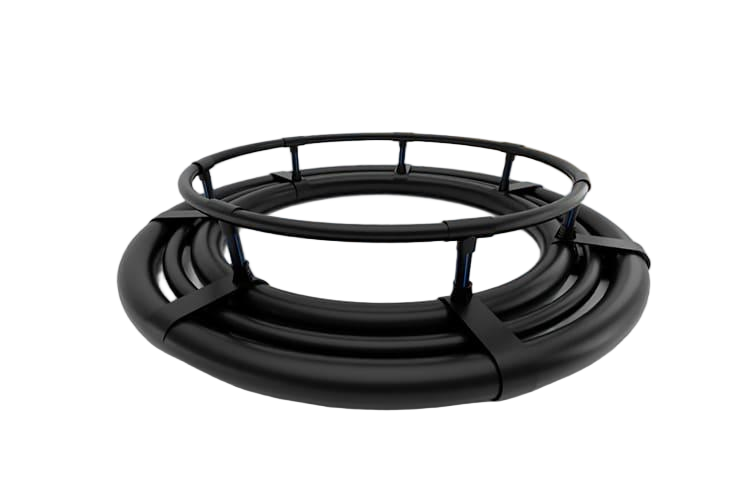
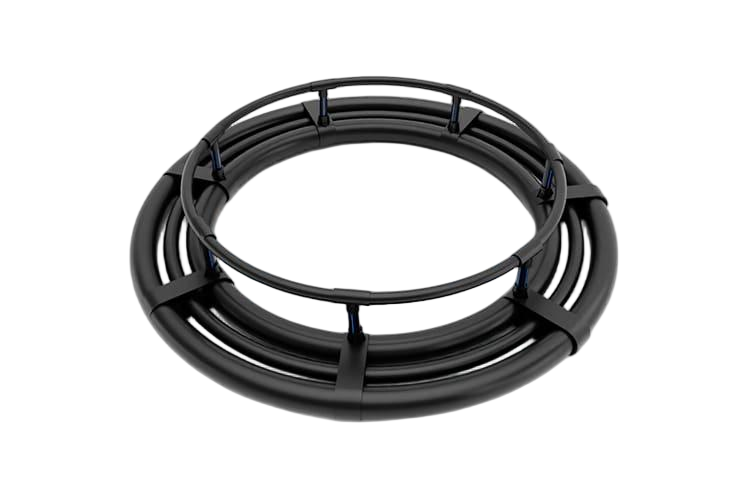
An HDPE floating cage is, at its core, a giant floating ring made of plastic pipe. Lengths of large-diameter HDPE pipe are butt-fusion-welded end to end into a closed circle to form the floating collar — most commonly two concentric rings (an inner and an outer floating pipe), and on bigger or more exposed cages three. Those rings are bound together at intervals all the way around by injection-moulded HDPE brackets, which also carry vertical posts called stanchions. The stanchions support a third, higher HDPE ring that serves as the handrail and the edge of the walkway crews stand on. Beneath the collar hangs the net bag that actually holds the fish, and at the bottom of the net a weighted ring — the sinker tube — keeps it stretched into shape. The whole assembly floats and is held in position by a grid of moorings. It looks simple, and that simplicity, built from a material that bends instead of breaking, is exactly why it works at sea.
The components, part by part
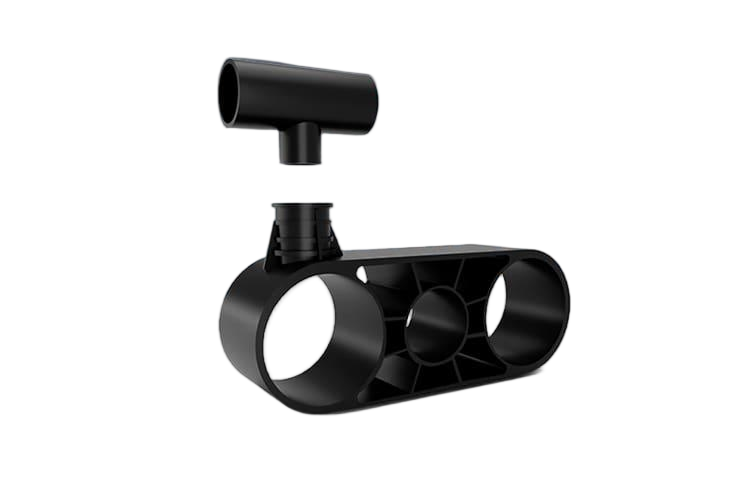
A floating cage is an assembly of a few well-defined parts, set out in the table. The floating collar — the concentric HDPE rings — provides the buoyancy and the structural frame. The brackets and stanchions bind the rings and carry the uprights, and their pins and stoppers are deliberately designed with 'swing space' so the collar can flex in waves rather than transmitting the load rigidly and cracking. The handrail pipe, welded onto the stanchions above the water, doubles as a safety rail and the edge of the working walkway. The net (the pen itself) is the knotless mesh bag that contains the fish. The sinker tube — an HDPE pipe filled with chain, typically weighing anywhere from 15 to 140 kg per metre depending on the currents — hangs at the bottom of the net to keep it open and stop it deforming. And the mooring grid of anchors, ropes and bridles holds the whole cage on station. Each part is matched to the site's wave and current loads.
| Component | What it is | Typical spec |
|---|---|---|
| Floating collar | 2–3 concentric HDPE rings, butt-fusion welded | Ø200–500 mm pipe; PE100 marine grade |
| Brackets & stanchions | Injection-moulded HDPE binding rings + carrying uprights | Spaced full circumference; pins/stoppers with 'swing space' |
| Handrail pipe | Welded HDPE ring above water on the stanchions | Doubles as walkway edge & safety rail |
| Net (pen) | Knotless mesh bag below the collar holding the fish | Sized to circumference; jumping/predator nets optional |
| Sinker tube / ring | HDPE pipe filled with chain; keeps the net open | 15–140 kg/m, matched to the current |
| Mooring grid | Anchors, ropes, chains and bridles holding station | Dimensioned to site wave/current loads (NS 9415) |
Why HDPE beat steel, timber and concrete
Marine fish cages were once built from steel, timber and concrete, and HDPE displaced all three — decisively — for reasons that all come back to surviving at sea. The big one is flexibility: HDPE deforms under wave load and dissipates the energy, then springs back, whereas rigid steel, timber and concrete fight the waves and crack or fatigue. That's the single property that made plastic win in exposed water. On top of it, HDPE is completely corrosion-free in seawater — no rust, no sacrificial anodes to replace as with galvanised steel, no rot as with timber. It's UV-stable thanks to carbon-black and added stabilisers, so it holds up under years of sun. It's inherently buoyant (a hollow, sealed pipe), so the collar floats without bolt-on flotation. It fuses into one leak-free monolithic ring. And it lasts — the collar structure is typically rated for 15 to 25 years of service while the HDPE material itself is a 50-year material, with low maintenance and full recyclability at end of life. Flexible, corrosion-proof, buoyant and durable is the exact specification a marine cage needs.
HDPE vs other cage materials
Set side by side with the materials it replaced, HDPE's advantages for marine cages are stark, and the table lays them out. On storm survival HDPE is excellent because it flexes and sheds wave energy, while steel is rigid and fatigues, timber is weak, and concrete — though massive — is brittle and cracks. On corrosion and rot HDPE is inert in seawater, where steel corrodes and needs anodes, timber rots, and concrete's reinforcement corrodes. On service life the HDPE collar runs 15–25 years (the material 50), against often just a few years for steel or timber at sea. HDPE needs little maintenance, is light and modular enough to tow and reconfigure, and has the lowest cost over its life. The alternatives each have a niche — concrete's mass, timber's low upfront cost — but for a structure that has to live in moving seawater for decades, HDPE wins on nearly every axis that matters.
| Factor | HDPE | Galvanised steel | Timber | Concrete |
|---|---|---|---|---|
| Storm survival | Excellent — flexes, sheds wave energy | Poor–fair — rigid, fatigues | Poor | Fair (mass) but brittle, cracks |
| Corrosion / rot | None — inert in seawater | Corrodes; needs anodes | Rots | Reinforcement corrodes |
| Service life | 15–25 yr (material ~50 yr) | Often a few years at sea | 3–5 yr | 20+ yr but very heavy |
| Maintenance | Low | High (anode replacement) | High | Moderate |
| Weight / logistics | Light, towable, modular | Heavy | Moderate | Very heavy, hard to deploy |
| Cost over life | Lowest | High | Low upfront, high lifecycle | High |
Sizing a cage: circumference, rings and site exposure
Fish cages are specified by their circumference rather than their diameter — you'll hear farmers talk about a '120-metre cage,' meaning 120 m around — and the diameter follows from it (diameter equals circumference divided by π, so a 120 m cage is about 38 m across). Commercial circles run from roughly 30 m up to around 260 m in circumference, with salmon-industry plastic pens commonly in the 60–240 m range. What sets the pipe size, the number of rings and the weight of the sinker tube is the site's exposure — the wave height and current it has to withstand. Sheltered sites use smaller pipe (around Ø200–315 mm) in a double-ring collar with lighter sinkers; exposed, high-energy sites step up to larger pipe (Ø400–500 mm), often a triple ring, heavier sinker tubes and stronger moorings. The required buoyancy and payload (walkways, equipment, feed) and the net depth feed in too. In short, you don't pick a cage off a shelf — you dimension the collar to the measured loads of the specific site.
NS 9415 & NYTEK: the standard behind every cage
Marine cage design is governed, more than by anything else, by a single Norwegian standard: NS 9415, currently NS 9415:2021, titled 'Floating aquaculture farms — site survey, design, execution and use.' Its sole purpose is to prevent the escape of fish, and it does that by setting requirements for the site survey, for verifying that the structure's strength resists the calculated environmental loads (waves, currents, wind), for the main components (the net/enclosure, the floater/collar, the raft and the anchoring), for the materials and how the components interact, and for a user handbook covering inspection and maintenance. It's worth being clear about what it does not cover — personal safety, working environment, fish health and electrical systems are all explicitly outside its scope (so any source claiming NS 9415 governs things like feed composition or wages is simply wrong). NS 9415 is made legally mandatory by Norway's NYTEK regulation (NYTEK23), which runs a certification regime: a site certificate plus product certification of the escape-critical components — collars, nets, moorings and their shackles and rings — by accredited bodies such as DNV. Even outside Norway, NS 9415 is the de facto reference the industry designs to.
Designing for waves and the move offshore
As sheltered inshore sites fill up, the industry has pushed into higher-energy and genuinely offshore waters, and that has stretched cage design hard. The governing loads are waves and currents, and the design philosophy is the same one that made HDPE win in the first place: the collar must flex to shed wave energy rather than resist it, the moorings must hold the cage on station against far larger forces, and the net and sinker must keep their shape in strong currents. Exposed sites drive the move to larger-diameter pipe, triple-ring collars, heavier sinker tubes and much stronger mooring grids. The frontier is striking — purpose-built offshore structures such as Ocean Farm 1 (around 110 m in diameter) and Arctic Offshore Farming (about 78 m across and 78 m deep) operate in open ocean conditions that would have been unthinkable for the first plastic pens. The common thread from the smallest sheltered cage to the largest offshore farm is dimensioning the flexible HDPE structure to the measured environmental loads.
5 design & operation mistakes to avoid
- Under-sizing the pipe and rings for the site's exposure — fitting a sheltered-water collar to a high-energy site invites fatigue cracking; match pipe diameter, ring count and sinker weight to the measured wave and current loads.
- Wrong sinker-tube weight — too light and the net loses volume and deforms in the current (fish stress, lower yield, snagging); the 15–140 kg/m must suit the site.
- Under-dimensioned moorings — the grid, bridles and anchors are the number-one cause of escapes; the cage is only as strong as its moorings.
- Poor butt-fusion welds — a bad weld becomes the failure point of the ring; welding must follow correct temperature, time and pressure.
- Over-rigid assembly / neglected maintenance — bolting the collar too tightly removes the flex that lets it survive storms, and skipping inspection and biofouling control adds load and reduces buoyancy.
Glossary
- Floating collar
- The buoyant frame of the cage: two or three concentric large-diameter HDPE rings (Ø200–500 mm) butt-fusion-welded into closed circles.
- Bracket & stanchion
- The injection-moulded HDPE clamp binding the rings and the upright it carries; pins/stoppers give deliberate 'swing space' for flex.
- Sinker tube / ring
- An HDPE pipe filled with chain (15–140 kg/m) hung at the bottom of the net to keep it stretched open in currents.
- Circumference sizing
- Cages are specified by circumference (~30–260 m); diameter = circumference ÷ π (a 120 m cage ≈ 38 m across).
- NS 9415
- The Norwegian standard for floating aquaculture farms; its sole aim is preventing fish escape (site survey, loads, components, moorings).
- NYTEK
- The Norwegian regulation that makes NS 9415 mandatory and runs the certification of escape-critical components (collars, nets, moorings).
References & standards
- [1]FAO — Aquaculture operations in floating HDPE cages — field handbook
- [2]Standards Norway — Floating aquaculture farms / NS 9415
- [3]Sands — NYTEK23 & NS 9415:2021 — technical requirements explainer
- [4]AKVA group — Polarcirkel plastic pens — 50 years of HDPE cage development
- [5]ScaleAQ — Sinker tube system (15–140 kg/m)
- [6]DNV — Aquaculture inspection & product certification
- [7]ScienceDirect — Modelling offshore aquaculture fish pens to environmental loads in high-energy regions
Frequently asked questions
Need expert advice on your project?
Our engineering team helps utilities, contractors and EPCs specify the right pipe material and SDR for their project. Get a no-obligation technical consultation.
Talk to an engineerRead next
12 min read
HDPE Pipe for Aquaculture: Fish Cages, Net Pens & Farm Piping (2026)
12 min read
HDPE Pipe Applications: Mining, Irrigation & Aquaculture Case Studies
12 min read
HDPE for Floating Solar, Pontoons & Floating Structures (2026)
15 min read
HDPE Pipe for Marine & Sewage Outfalls and Seawater Intakes: Float-and-Sink, Ballast & Diffusers (2026)
13 min read
HDPE Dredging & Marine Pipe: Floating Pipelines, Floaters & Ballast (2026)
Explore further
Related applications, material comparisons and country buying guides selected for this topic.