Application
HDPE Pipe for Rural & Stock Water Supply Schemes: Long-Distance Reticulation Done Right (2026)
A rural water line fails in two predictable ways: it's undersized for the friction over kilometres, or it bursts at the bottom of a hill under static head. Both are design mistakes, not pipe faults — and both are avoidable once you size for distance and pick the pressure class for the lowest point.

Dr. Wei Liu, P.E.
Senior Engineering Manager · Primepoly
Published: Jun 15, 2026
Updated: Jun 20, 2026
15 min read
TL;DR
A practical engineering guide to HDPE/PE pipe for rural and stock (livestock) water supply: why long coils and fused/compression joints make PE the rural standard, verified livestock daily water demand, the four-hour peak-demand sizing rule, how to size for friction over long distances (with the honesty that PE has more friction than PVC per nominal size), pressure management on hilly terrain (PN class for the static head, break-pressure tanks, PRVs, air valves and washouts), storage and trough/float-valve detail, mole-ploughing and burial, and an honest comparison with galvanised steel, PVC and lay-flat.
Getting water across a farm or out to a scattered rural community is a very different problem from piping a town. The loads are small but the distances are long, the terrain is rarely flat, and the points of use — troughs, tanks, farmhouses — are spread out over kilometres. That combination is exactly what polyethylene pipe was made for: it comes in long coils with almost no joints, it's light enough to lay by hand or pull in behind a plough, it doesn't corrode, and it bends to follow the ground. But the same combination also sets two traps that catch people out again and again: undersizing the pipe for the friction loss that builds up over distance, and bursting the line at the bottom of a hill where the static pressure is highest. This guide shows how to size for distance, manage pressure on hills, and build a rural scheme that lasts.
What rural & stock water reticulation is
Rural water reticulation means piping water from a source — a bore or well, a dam, a header tank, or a town main connection — out to scattered points of use across a property or district: farmhouses, livestock troughs, sheds, and remote village standpipes. Unlike a compact urban network, a rural scheme typically runs small-diameter pipe over long distances, often across undulating or hilly terrain, to deliver relatively modest flows. Stock water (livestock water) is the classic version: long pipelines feeding troughs across grazing country, frequently combined with domestic supply in a 'stock and domestic' scheme. The defining engineering challenges are distance and elevation — pushing enough water far enough, and managing the pressure that builds up wherever the line drops downhill. Get those two right and the rest follows.
Why HDPE is the default pipe for rural schemes
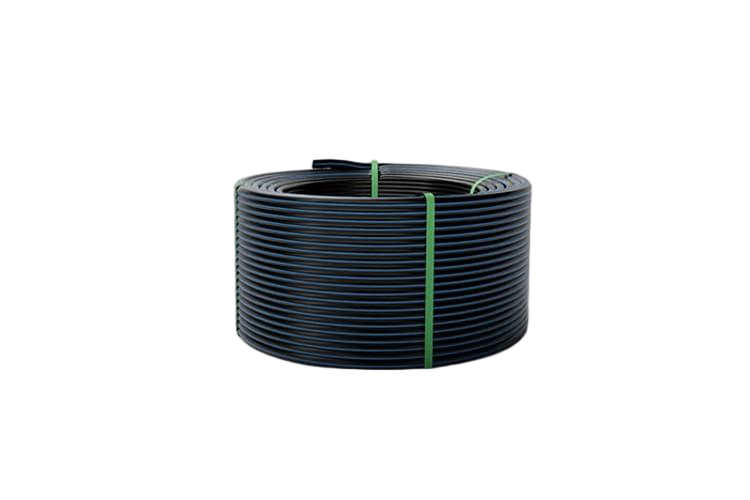
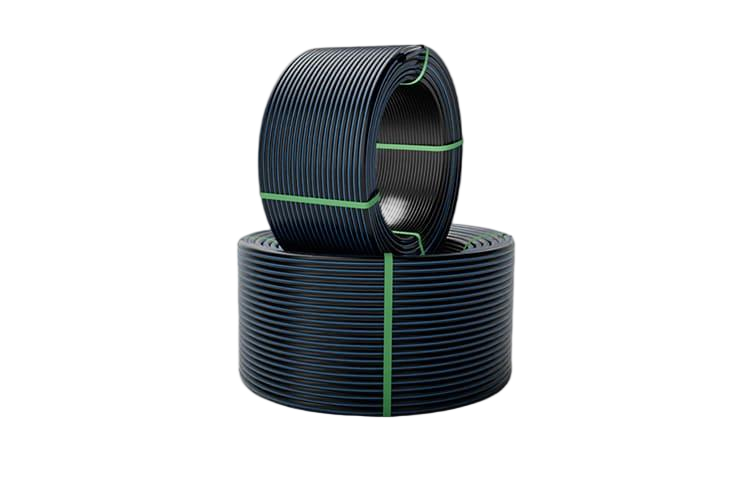
Polyethylene became the standard rural water pipe for a stack of practical reasons that all matter over long, scattered runs. It's supplied in long coils — up to about 300 metres for the smaller diameters — so a kilometre of pipeline can go in with only a handful of joints, and joints are where rural lines leak and fail. It's light, so a crew can roll it out by hand or pull it straight into the ground behind a mole plough without heavy lifting gear. It doesn't corrode, unlike galvanised steel, so buried life runs to around fifty years. It's flexible, so it follows the contours of undulating ground and tolerates rocky trenches far better than rigid, brittle PVC. The black grades are UV-stable for the short above-ground stretches every farm has. And it joins leak-free at any scale — compression fittings for the small sizes (no special tools), electrofusion and butt fusion for the larger mains. Light, tough, corrosion-free and jointed sparingly is exactly the rural brief.
How much water do your animals need?
Every rural water design starts with demand, and for stock water that means knowing how much your animals actually drink — which varies widely with class, weather and feed. The table gives verified daily figures. Two principles matter more than the exact numbers. First, design for the worst case, not the average: a lactating animal on dry summer feed in the heat can drink at the very top of its range, and hot weather can roughly double consumption, so size for a hot day with stock in milk. Second, remember that animals drink in groups, mostly morning and evening — so the pipe feeding a trough has to deliver the full day's water in only a few peak hours, not spread evenly over 24. Getting the demand and the peak right is the foundation; everything downstream is sized to meet it.
| Stock class | Litres / head / day |
|---|---|
| Weaner / young sheep | 2–4 |
| Adult dry sheep | 2–6 |
| Ewes with lambs (lactating) | 4–10 |
| Young / growing cattle | 25–50 |
| Dry cattle (~400 kg) | 35–80 |
| Lactating dairy cow | 40–100 (to ~200 at high milk yield) |
| Mature horse (~500 kg) | 25–55 |
Sizing pipe for low flow over long distance
Here's the trap that catches most rural schemes: sizing the pipe by flow velocity alone and ignoring how friction loss piles up over distance. At the low flows typical of rural lines, it's friction over the length — not velocity — that governs, and it grows fast as the pipe gets smaller. A worked example from the livestock-engineering literature makes the point vividly: a 7.5 gpm gravity line running 2,000 ft with about 100 ft of available fall fails on ¾-inch pipe (around 240 ft of friction loss) and on 1-inch pipe, but works easily on 1¼-inch — going up two sizes cut the friction loss roughly twelve-fold over the same distance. So size for the cumulative head loss along the whole run, keep velocity under about 1.5 m/s (5 ft/s) to limit friction and surge, and use a Hazen-Williams C around 140 for PE. One honesty point worth making, because competitors fudge it: PE does not have lower friction than PVC of the same nominal size — its insert fittings and bore actually give it somewhat higher friction. PE wins on coils, jointing, flexibility and corrosion, not on raw hydraulics.
Pressure management on hilly terrain
Long rural lines rarely run on the flat, and elevation is where pressure problems — and burst pipes — come from. The key insight is that the maximum pressure in a gravity line occurs when it's static (no flow), at the lowest point, where the full static head of every metre of fall above it bears on the pipe. So you pick the pressure class for that static head, not for the operating pressure: roughly PN8 for up to about 80 m of head, PN12.5 for up to ~125 m, PN16 for up to ~160 m, with a safety margin (the common rule is keeping the working pressure at or below about 72% of the rating). This is where a very common and costly mistake lives: 'rural' green-stripe PE pipe is often only PN8, a low-pressure product, and using it where the hills impose more static head than that calls for metric blue-stripe PN12.5 or PN16 pipe instead. On long descents, break-pressure tanks (which reset the pressure to atmospheric and let you drop to a lower PN downstream) or pressure-reducing valves cap the head. And don't forget the fittings that keep a hilly line working: air-release valves at every high point (air pockets collect at crests and throttle the low-velocity flow), and washout/scour valves at every low point for flushing sediment and draining the line.
Designing the scheme: a step-by-step path
A rural scheme comes together in a clear sequence — from source and demand through pipe size, pressure class and the protective valves. The path below walks it. The two steps people skip are sizing for the static head at the lowest point (not the operating pressure) and putting air valves and washouts at the high and low points.
Installation: coils, mole-ploughing and burial
Rural PE is usually installed straight from the coil, and the fastest method on open country is mole-ploughing: a tractor-drawn plough cuts a narrow slot and feeds the pipe in behind the blade, burying it in one pass with almost no trench — up to about 5,000 m a day in good soils, to a depth of around 2 m, for pipe up to roughly 90 mm fed directly from the coil (larger diameters are surface-laid and picked up by the plough). There's a real-world catch worth knowing: joints won't pass through a mole plough, so the length of your coil sets the length of your jointless pull — another reason long coils matter. Whatever the method, bury the pipe below the local frost line and deep enough to protect it from stock and vehicle traffic (commonly at least 300 mm, more under roads and cultivation). And note the freeze caveat: PE is more frost-tolerant than rigid PVC because it flexes rather than shattering, but it is freeze-resistant, not freeze-proof — repeated freezing degrades it, so depth still matters in cold climates. The video shows the mole-ploughing method in the field.
HDPE vs galvanised steel, PVC and lay-flat
Against the alternatives a rural builder might consider, PE is the all-rounder, and the table is honest about where it doesn't lead. Galvanised steel is rigid, heavy and full of threaded joints that corrode — fine for short above-ground runs and fittings, poor for long buried lines. Rigid PVC is cheaper per length and actually has slightly lower friction than PE, but it comes in short glued sticks (many joints over distance), is brittle in cold and rocky ground, and degrades in sunlight so it can't be used above ground. Lay-flat hose is the lightest and rolls up, which suits temporary or portable supply, but it's fragile, UV-sensitive and short-lived — not a permanent buried main. PE's blend of long jointless coils, corrosion immunity, terrain-following flexibility, UV-stable above-ground capability and leak-free jointing is why it's the default for the permanent buried backbone of a rural scheme, with the others filling niche roles around it.
| Aspect | HDPE/PE | Galvanised steel | PVC | Lay-flat |
|---|---|---|---|---|
| Joints over km | Very few (long coils, fused) | Many threaded joints (corrosion sites) | Glued every ~6 m | Many; not for permanent burial |
| Corrosion | None | Corrodes (zinc only delays) | None | None |
| Terrain following | Excellent (flexible) | Poor (rigid) | Poor (rigid, cold-brittle) | Flexible but fragile |
| UV / above-ground | Yes (black, UV-stable) | Yes | No — degrades; bury only | No (degrades fast) |
| Best role | Long buried rural mains & reticulation | Short above-ground runs, fittings | Cheaper buried straight runs | Temporary / portable supply |
5 mistakes that wreck rural water pipelines
- Undersizing for friction over distance — sizing by velocity and ignoring the cumulative head loss over kilometres (going up a size can cut friction loss many-fold).
- No pressure management on hills — using one PN class throughout and bursting at the lowest point under static head; skipping break-pressure tanks or PRVs on long descents.
- No air valves at high points — air pockets collect at crests and throttle or stop the low-velocity flow.
- Using low-pressure green-stripe PN8 rural pipe where the static head needs metric blue-stripe PN12.5/PN16 — a classic, costly mismatch.
- Exposing non-UV pipe or burying too shallow — coloured/thin-wall pipe degrading above ground, or burial too shallow for frost, stock and vehicles.
Glossary
- Stock & domestic scheme
- A rural pipeline carrying both livestock (trough) water and domestic supply; domestic use requires potable-certified pipe.
- Static head
- The pressure from elevation difference when the line isn't flowing — maximum at the lowest point, ~9.81 kPa per metre of fall; it sets the PN class.
- PN class (green vs blue stripe)
- The pressure rating: green-stripe rural PE is often only PN8 (~80 m head); metric blue-stripe PE100 runs PN12.5/PN16 for big hills.
- Four-hour peak rule
- Sizing the trough line to deliver the full daily water demand in ~4 hours, because livestock drink in groups morning and evening.
- Break-pressure tank
- A tank on a long descent that resets the pressure to atmospheric, capping static head and letting a lower-PN pipe be used downstream.
- Mole-ploughing
- Pulling coiled PE pipe straight into a narrow plough-cut slot (≤~90 mm from coil, ~2 m deep, to ~5,000 m/day) — joints won't pass the plough.
References & standards
- [1]BC Ministry of Agriculture — Livestock Water Design #2 — selecting small-diameter pipe (friction tables, worked examples)
- [2]NSW Local Land Services — Reticulated water systems for livestock (demand, peak flow, troughs)
- [3]NDSU Extension — Livestock water requirements (consumption by class & temperature)
- [4]Vinidex — PE pipe selection — PN/SDR, PE80/PE100 explained
- [5]Iplex — Poliplex PE100 (HDPE) pressure pipe — PN8–PN16, coils to 300 m
- [6]PE100+ Association — Mole-ploughing — installation guidance (coil limit, depth, rate)
- [7]Plastics Pipe Institute — HDPE piping to supply water to rural villages (Morocco gravity scheme)
Frequently asked questions
Need expert advice on your project?
Our engineering team helps utilities, contractors and EPCs specify the right pipe material and SDR for their project. Get a no-obligation technical consultation.
Talk to an engineerRead next
13 min read
HDPE Pipe for Irrigation: Drip, Sprinkler & Farm Mains (2026)
14 min read
Designing an HDPE Water Distribution Network: Layout, Sizing, Pressure & Leakage (2026)
13 min read
HDPE Pipe Hydraulic Design & Flow Capacity: Sizing, Head Loss & Velocity (2026)
13 min read
HDPE Service Connections & Tapping: Branch Saddles, Tapping Tees & Under-Pressure Tapping (2026)
12 min read
HDPE Pipe Size & Dimension Chart: OD, SDR, PN & Wall Thickness (2026)
Explore further
Related applications, material comparisons and country buying guides selected for this topic.