Comparison
HDPE vs Spiral-Welded Steel Pipe for Large-Diameter Water Transmission: Corrosion, Joints & Lifecycle Cost (2026)
Spiral-welded steel can go bigger and take more pressure than HDPE — that part isn't close. The honest contest is everything that happens after commissioning: corrosion protection, leak-tight joints, and the flow capacity that steel slowly loses while HDPE keeps. That's where the lifecycle decision is really made.

Dr. Wei Liu, P.E.
Senior Engineering Manager · Primepoly
Published: Jun 19, 2026
Updated: Jun 20, 2026
15 min read
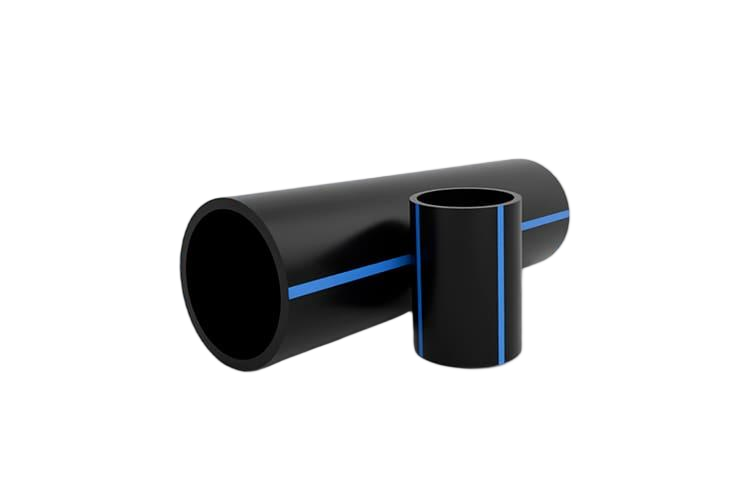
TL;DR
An honest, standards-cited comparison of HDPE (PE4710/PE100, AWWA C906) and spiral-welded steel pipe (SSAW) for large-diameter water transmission mains: how each is made, the corrosion divide (steel needs lining + coating + cathodic protection + field-joint coating; HDPE needs none), field-welded joints vs monolithic heat fusion, the Hazen-Williams C-factor that holds flat for HDPE but declines for metallic pipe, where steel genuinely wins (very high pressure, very large diameter, penstocks, surface crossings), where HDPE wins (corrosive soils, seismic, trenchless, lowest lifecycle cost), and the standards.
When a utility plans a large-diameter water transmission main, the material choice often comes down to two candidates: spiral-welded steel pipe, the long-standing workhorse for big high-pressure mains, and HDPE, the corrosion-free polymer that has climbed steadily into larger diameters. Most online comparisons are partisan — the steel makers defend steel, the plastics makers oversell HDPE with claims like 'steel only lasts twenty years' that don't survive scrutiny. This one is written by an HDPE manufacturer but plays it straight, because the honest version is more useful and more credible. Steel genuinely wins on some axes — very high pressure, very large diameter, penstocks — and we'll say so plainly. The real contest, and where HDPE makes its case, is everything that happens over the fifty-to-hundred-year life of the main: corrosion protection, joint integrity, and flow capacity that doesn't decay.
HDPE vs spiral-welded steel at a glance
Before the detail, the table sets the two materials side by side across the dimensions that decide a transmission main. Read it as a map of where each pipe's strengths lie: steel commands the top of the diameter and pressure ranges, while HDPE commands corrosion immunity, joint leak-tightness, flexibility and the flow capacity that stays put over decades. Almost every row below is a genuine trade-off rather than a knockout — which is exactly why the choice depends on the project's pressure, diameter, ground conditions and whose lifecycle cost you're counting. The sections after the table work through the rows that matter most.
| Dimension | Spiral-welded steel | HDPE (PE4710 / C906) |
|---|---|---|
| Max diameter | Up to ~3,600 mm (AWWA C200) | 1,650 mm (C906); larger non-standard |
| Pressure rating | High; suits penstocks / high head | Up to ~250 psi (DR9); derates with temperature |
| Corrosion protection needed | Lining + coating + usually CP + field-joint coating | None |
| Joint method / leakage | Field weld + field coat; very tight | Butt fusion; zero leakage, fully restrained |
| Service life | Indefinite — WITH maintained CP/coatings | 50–100 yr design life, no maintenance |
| Seismic / settlement | Stiff; weld stress points | Excellent (flexible, ductile) |
| Weight / handling | Heavy | ~1/8 of steel; long fused strings |
| Roughness over time | C drops as it tuberculates | Stable C ≈ 150 for life |
| Repair | Hot work, recoat | Fuse-in replacement |
| Lifecycle cost where corrosion dominates | Higher (ongoing protection) | Lowest |
How each is made
The two pipes start from completely different places. Spiral-welded steel pipe — SSAW, sometimes called HSAW — is made by taking a coil of hot-rolled steel, forming it helically into a tube, and joining the spiral seam with double-sided submerged-arc welding; it's the standard way to make large steel water pipe above about 24 inches, and it can be produced in very large diameters. HDPE is extruded as a homogeneous polyethylene wall from PE4710/PE100 resin, then either coiled (small sizes) or supplied in straight lengths and joined by heat fusion into continuous strings. The consequence of those two processes runs through the whole comparison: the steel pipe has a welded metal wall that will corrode unless it's protected and has seams and field joints to manage, while the HDPE pipe has an inert plastic wall that won't corrode and fuses into one monolithic length. Manufacturing method, in other words, sets up the corrosion and joint stories that follow.
Corrosion: the lifecycle divide
Corrosion is the single biggest difference between the two, and it's where HDPE's lifecycle case is built. A buried steel main cannot simply be put in the ground bare — it needs a full corrosion-protection system: an internal lining (cement-mortar to AWWA C205, or an epoxy to C210/C213) to protect the bore, an external coating to protect the outside, and usually cathodic protection on top of that, with every field-welded joint coated in the trench. All of that has to be designed, installed correctly, monitored and maintained for the life of the pipeline — and any gap in the coating or lapse in the cathodic protection becomes a corrosion site. HDPE, being an inert polymer, needs none of it: no lining, no coating, no cathodic protection, no field-joint coating, ever. It's immune to electrolytic and galvanic corrosion, to tuberculation, and to most aggressive soils and waters. That's not a small saving — it removes an entire system of ongoing cost, inspection and failure risk from the project, which is why HDPE is so strongly favoured in corrosive or aggressive ground.
Joints and leakage
After corrosion, the joints are the next big divide. Spiral-welded steel mains are joined in the field — typically welded — and each joint then has to be coated in the trench to protect it, which is skilled, weather-sensitive work and another place corrosion can start. HDPE is joined by butt heat fusion, which melts the pipe ends together into a single monolithic joint that is as strong as the pipe wall, fully restrained, and has zero allowable leakage. That full restraint is a quiet but real advantage: a fused HDPE line resists the thrust at bends and tees through the joints themselves, so it doesn't need the thrust blocks a gasketed bell-and-spigot system would (thrust forces still exist and must be considered, but the joints don't pull apart). For a water utility, the leakage difference matters directly — non-revenue water lost through joints is a perennial cost, and a fused HDPE main essentially eliminates joint leakage for its whole life.
Flow capacity over time: the C-factor story
Here's the comparison that's easiest to overlook and hardest to argue with: how the pipe's flow capacity changes over its life, captured by the Hazen-Williams roughness coefficient C (higher is smoother and carries more flow). HDPE starts smooth and stays smooth — a design C of about 150 that holds essentially flat for the entire service life, because the inert wall doesn't corrode, tuberculate or scale; AWWA's PE design guidance says no flow-capacity reduction need be assumed over time. Metallic pipe is a different story: it starts respectable, around C ≈ 130 when new, but as it tuberculates and corrodes the coefficient falls over the decades to somewhere around 60–100, meaning the same pipe carries progressively less water and the pumps work progressively harder. The chart shows the contrast — a flat HDPE line against a declining metallic one. Over a fifty-year horizon that gap is real money in pumping energy and lost capacity, and it's one of HDPE's most defensible quantitative advantages.
Source: AWWA M55 / Uni-Bell / PPI
Where steel still wins
An honest comparison has to credit steel where it genuinely leads, and the cases are clear. The first is pressure: for very high working pressures and high-head applications, spiral-welded steel simply has more headroom than HDPE, whose top pressure classes (around DR9 at 250 psi) and temperature derating cap what it can do. The second is diameter: steel is routinely made far larger than HDPE's standardised ceiling — AWWA C906 lists PE up to 1,650 mm, and while solid-wall HDPE can be extruded larger, steel goes to 3,000 mm and beyond as standard product. The third is penstocks — high-head hydropower conduits are classic steel territory. And the fourth is surface, aerial and bridge crossings, where steel's stiffness lets it span and resist external loads, and where fire resistance and rigidity matter. Where the duty pushes past HDPE's pressure or diameter range, or the pipe runs above ground under load, steel is the right answer — and a good engineer says so.
Where HDPE wins
On the other side, HDPE wins decisively in a well-defined set of conditions. Corrosive and aggressive soils and waters are the clearest case: where steel would need an elaborate and perpetually-maintained corrosion-protection system, HDPE is simply immune, which collapses both the lifecycle cost and the failure risk. Seismic zones and areas of ground settlement or subsidence favour HDPE because its flexible, ductile, fully-fused line flexes and stretches where a stiff welded steel line concentrates stress. Trenchless installation — horizontal directional drilling, pipe bursting, sliplining — plays to HDPE's strength because long fused strings can be pulled in, and this is a large and growing share of pipeline work. And for mid-pressure transmission within HDPE's diameter range, on any project where corrosion dominates the lifecycle cost, HDPE delivers the lowest total cost of ownership. The pattern is consistent: wherever corrosion, ground movement or trenchless installation drives the project, HDPE is the stronger choice.
How to choose: a decision path
The choice resolves cleanly once you weigh the project's pressure and diameter against its ground conditions and lifecycle priorities. The path below walks the five questions that decide it, in the order that usually matters.
5 selection considerations
- Required pressure and diameter — does the duty exceed HDPE's pressure classes or its ~1,650 mm standardised range, or need a penstock? If yes, lean steel.
- Soil and water corrosivity — aggressive ground massively favours HDPE; steel there means cathodic protection, coatings and lifelong monitoring.
- Seismic and settlement risk — flexible, fully-fused HDPE is strongly preferred where the ground moves; stiff welded steel concentrates stress.
- Installation method — trenchless (HDD, bursting, sliplining) and long-string pulls favour HDPE; surface, aerial and bridge crossings favour steel.
- Lifecycle cost and O&M capacity — can the owner sustain cathodic-protection monitoring and recoating? If not, HDPE's maintenance-free corrosion immunity wins.
Glossary
- Spiral-welded steel (SSAW)
- Large-diameter steel pipe made by helically forming steel coil and submerged-arc welding the spiral seam; common ~219–3,200 mm.
- Submerged-arc welding (SAW)
- The welding process forming the spiral seam (and field joints) of SSAW steel pipe.
- SDR / DR
- Standard/Dimension Ratio — pipe OD ÷ wall thickness; the lower the DR, the thicker the wall and higher the pressure class (e.g. DR9 = 250 psi).
- Cathodic protection (CP)
- An electrochemical system that suppresses corrosion of buried steel; required and maintained for the life of a steel main — HDPE needs none.
- Tuberculation
- The corrosion nodules that grow inside metallic pipe over time, roughening the bore and dropping its Hazen-Williams C and flow capacity.
- Hazen-Williams C
- The flow-roughness coefficient; HDPE holds C ≈ 150 for life, metallic pipe falls from ~130 new toward ~60–100 as it corrodes.
- Butt fusion
- Heat-fusing HDPE pipe ends into a monolithic, fully-restrained, zero-leakage joint as strong as the pipe wall.
- Penstock
- A high-head pressure conduit feeding a hydro turbine — classic spiral-welded-steel territory at large diameter and high pressure.
References & standards
- [1]AWWA — C906 — polyethylene (PE) pressure pipe, 4 in.–65 in. (100–1,650 mm)
- [2]AWWA — C205 — cement-mortar lining & coating for steel water pipe
- [3]Northwest Pipe — Large-diameter transmission pipeline corrosion control (steel)
- [4]STI/SPFA — AWWA M11 — steel pipe: a guide for design & installation
- [5]Plastics Pipe Institute — A sustainable 100-year design life with HDPE
- [6]Uni-Bell — Hazen-Williams flow coefficient declines over time (metallic pipe)
- [7]PE100+ Association — Range of HDPE pipe dimensions available
- [8]AGRU — World's largest HDPE pipe — solid-wall to 3,500 mm OD
Frequently asked questions
Need expert advice on your project?
Our engineering team helps utilities, contractors and EPCs specify the right pipe material and SDR for their project. Get a no-obligation technical consultation.
Talk to an engineerRead next
11 min read
HDPE vs Steel & Ductile Iron: A Total Cost of Ownership Comparison
13 min read
HDPE vs Ductile Iron Pipe for Water Mains: An Honest Comparison (2026)
14 min read
Designing an HDPE Water Distribution Network: Layout, Sizing, Pressure & Leakage (2026)
12 min read
HDPE Pipe for Hydropower & Micro-Hydro Penstocks (2026)
14 min read
HDPE Pipe & Earthquakes: Why Fused Polyethylene Survives Seismic Ground Movement (2026)
Explore further
Related applications, material comparisons and country buying guides selected for this topic.