Guide
What Is PE100? HDPE Pipe Grade Meaning, Properties & Ratings
A field engineer's guide to the PE100 polyethylene grade — what the '100' means, how it compares with PE80 and PE4710, and how its SDR/PN pressure ratings work.

Dr. Wei Liu, P.E.
Senior Engineering Manager · Primepoly
Published: Jul 5, 2026
Updated: Jul 5, 2026
14 min read
TL;DR
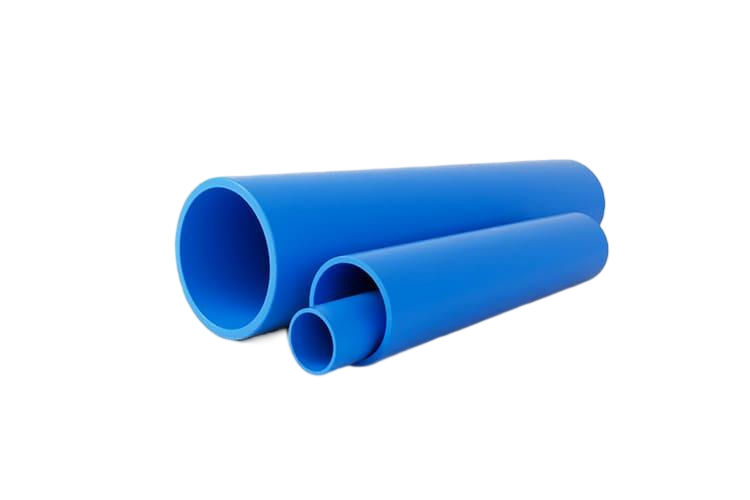
PE100 is the high-density polyethylene grade with a Minimum Required Strength of 10 MPa — the modern standard for HDPE pressure pipe. Here's what PE100 means, how it differs from PE80, PE63 and PE4710, its key properties, SDR/PN ratings and where it is used.
If you have specified, bought or laid HDPE pipe, you have seen "PE100" stamped on the wall — but the designation is more than a product code. It tells you the exact long-term strength the resin is certified to, which in turn sets the wall thickness and pressure rating of every pipe made from it. This guide explains precisely what PE100 means, where the number comes from, how it compares with the older PE80/PE63 grades and the North-American PE4710 designation, and how to read its SDR and PN ratings — the knowledge you need to specify or verify PE100 pipe correctly.
What does PE100 actually mean?
PE100 stands for polyethylene (PE) with a Minimum Required Strength (MRS) of 10.0 MPa. The "100" is simply the MRS multiplied by ten, a naming convention fixed by ISO 12162. So PE100 = MRS 10.0 MPa, PE80 = MRS 8.0 MPa and PE63 = MRS 6.3 MPa. It is a classification of the raw polyethylene compound, not a brand — any resin that passes the test can be called PE100.
The MRS value is not a short-term tensile number. It is the hoop stress the material can safely withstand for 50 years of continuous internal water pressure at 20 °C, obtained by pressure-testing samples over thousands of hours and extrapolating the failure curve to 50 years using the regression method in ISO 9080. Dividing the MRS by the design (safety) coefficient — 1.25 for water under ISO 4427 — gives the design stress σs used to calculate the pipe's pressure rating. For PE100, that is 10.0 ÷ 1.25 = 8.0 MPa.
PE100 vs PE80 vs PE63: the polyethylene grades
Three MRS-classified grades appear in ISO 4427. PE63 is effectively obsolete for pressure pipe. PE80 is still used for smaller-diameter gas mains and some legacy systems. PE100 is the current standard for virtually all new municipal water and gas pressure pipe, because its higher strength lets a thinner wall carry the same pressure — saving material, weight and cost.
| Grade | MRS (MPa) | Design stress σs (MPa) | Status today |
|---|---|---|---|
| PE63 | 6.3 | 5.0 | Legacy — largely obsolete for pressure pipe |
| PE80 | 8.0 | 6.3 | Still used for gas & small-diameter mains |
| PE100 | 10.0 | 8.0 | Current standard for pressure water & gas pipe |
The three properties that define PE100
A resin only qualifies as PE100 when it balances three long-term properties simultaneously. A compound can be strong in one and fail in another; PE100 has to satisfy all three, which is why it took the industry two decades of resin chemistry to reach it.
- Minimum Required Strength (MRS) — 10 MPa of long-term (50-year, 20 °C) hydrostatic strength. This is the property the '100' refers to and the number that sets the pressure rating.
- Slow Crack Growth (SCG) resistance — resistance to the slow, brittle cracks that quietly end the life of older polyethylenes at points of stress concentration. The PE100-RC grade raises this dramatically for no-sand-bed, trenchless and rocky-trench installation.
- Rapid Crack Propagation (RCP) resistance — the ability to arrest a fast-running crack instead of letting it unzip along the pipe. This matters most for large-diameter gas and high-pressure water mains.
PE100 vs PE4710: the same pipe, two rating systems
Buyers working across ISO and North-American projects often ask whether PE100 and PE4710 are different materials. They are not — they are broadly equivalent grades classified under two different systems. PE100 is the ISO/EN designation (based on MRS in MPa); PE4710 is the ASTM/PPI designation, where the digits encode density class (4), slow-crack-growth class (7) and a hydrostatic design stress of 1000 psi with a 0.63 design factor at 23 °C. In practice a modern bimodal resin is dual-listed as both PE100 and PE4710.
PE100-RC: the crack-resistant grade
PE100-RC ("Resistant to Cracking") is a PE100 that additionally passes stringent slow-crack-growth tests (such as the notched-pipe and Full-Notch Creep Test). Because it tolerates point loads from stones and uneven bedding, PE100-RC allows sand-bed-free trench installation and trenchless methods (horizontal directional drilling, pipe bursting, sliplining) — cutting excavation cost. It carries the same MRS and pressure ratings as standard PE100; the difference is durability under mechanical stress, not pressure capacity.
How PE100 pressure rating works: SDR and PN
PE100 is one grade, but it is sold in a range of pressure classes set by the wall thickness. SDR (Standard Dimension Ratio) is the ratio of outside diameter to wall thickness — a lower SDR means a thicker wall and a higher pressure rating. PN (Nominal Pressure) is the resulting allowable working pressure in bar at 20 °C. Because PE100 has a fixed design stress (8.0 MPa), each SDR maps to a specific PN, shown below. Above 20 °C the PN must be de-rated.
| SDR | Wall vs OD | PN @ 20 °C (PE100) | Typical use |
|---|---|---|---|
| SDR 41 | 1 / 41 | PN 4 | Gravity / very low pressure |
| SDR 26 | 1 / 26 | PN 6.3 | Low-pressure mains, drainage |
| SDR 17 | 1 / 17 | PN 10 | Distribution water mains |
| SDR 11 | 1 / 11 | PN 16 | Trunk mains, gas, general pressure |
| SDR 9 | 1 / 9 | PN 20 | High-pressure / pumped lines |
| SDR 7.4 | 1 / 7.4 | PN 25 | Mining slurry, high static head |
How PE100 pipe is manufactured
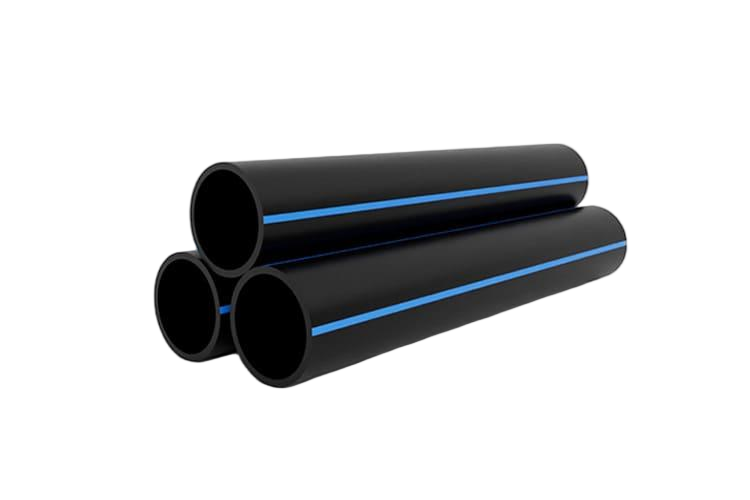
PE100 pipe is made by extrusion: virgin PE100 resin (typically bimodal, from producers such as Borealis, SABIC, Sinopec or PetroChina) is melted, forced through an annular die, sized under vacuum, cooled in water baths and cut or coiled. Carbon black is added for UV protection in black pipe, or co-extruded stripes identify the service. The extrusion stage sets the outside diameter and wall thickness — and therefore the SDR and pressure class — so tight process control here is what keeps every metre within ISO 4427 / EN 12201 tolerance. The short clip below shows PE100 DN225 SDR11 pipe in production.
Where PE100 pipe is used
PE100's combination of leak-free fused joints, corrosion immunity, flexibility and 50–100-year design life makes it the default material for a wide span of buried and marine infrastructure: potable water trunk and distribution mains, fuel-gas distribution, mining and tailings slurry lines, agricultural and drip irrigation, dredging and marine outfalls, industrial process water and cable-duct systems. The decision logic below shows how the grade and SDR are typically chosen.
Common misconceptions about PE100
- "PE100 and HDPE are different materials." They are not. PE100 is a grade of HDPE (high-density polyethylene). 'HDPE' names the polymer family; 'PE100' names its certified long-term strength class within that family.
- "A higher SDR number means a stronger pipe." The opposite is true. A higher SDR means a thinner wall relative to diameter and therefore a lower pressure rating — SDR 11 (PN16) is thicker and stronger than SDR 17 (PN10).
- "PE100 and PE4710 are incompatible." They are broadly equivalent grades under two rating systems (ISO/EN vs ASTM/PPI). Any difference in stated pressure comes from different design coefficients, not from a different resin.
- "PE100 can't handle high pressure." PE100 is rated to PN25 (25 bar) and beyond in low-SDR walls, and routinely carries mining slurry at higher static heads than PVC can sustain.
PE100 in one paragraph
PE100 is the high-density polyethylene grade certified to a 50-year, 20 °C long-term strength of 10 MPa (MRS 10.0). That strength, combined with slow- and rapid-crack-growth resistance, lets PE100 pipe run thinner walls, fully fused leak-free joints and a 50–100-year service life — which is why it has become the world standard for pressure water and gas pipe. When you specify PE100, you then pick the SDR/PN class for your working pressure, and PE100-RC where the installation is tough on the pipe wall.
PE100 glossary
- PE100
- Polyethylene resin grade with a Minimum Required Strength (MRS) of 10.0 MPa — the modern standard for HDPE pressure pipe. Equivalent to PE4710 in the North-American ASTM/PPI system.
- MRS (Minimum Required Strength)
- The 50-year, 20 °C long-term hydrostatic strength of the resin in MPa, derived by ISO 9080 regression and classified by ISO 12162. MRS × 10 gives the PE grade name.
- SDR (Standard Dimension Ratio)
- Ratio of pipe outside diameter to wall thickness. A lower SDR = thicker wall = higher pressure rating.
- PN (Nominal Pressure)
- The allowable continuous working pressure of the pipe in bar at 20 °C. For PE100 each SDR corresponds to a fixed PN (e.g. SDR 11 = PN 16).
- PE100-RC
- A PE100 with enhanced resistance to slow crack growth (RC = Resistant to Cracking), allowing sand-bed-free and trenchless installation at the same pressure rating.
- PE4710
- The ASTM/PPI designation broadly equivalent to PE100: density class 4, SCG class 7, hydrostatic design stress 1000 psi with a 0.63 design factor at 23 °C.
References & further reading
- [1]PE100+ Association — The meaning of the PE80 / PE100 / PE100-RC designations
- [2]ISO — ISO 12162 — Thermoplastics materials for pipes and fittings: classification, designation and design coefficient
- [3]ISO — ISO 9080 — Determination of long-term hydrostatic strength by extrapolation
- [4]ISO — ISO 4427 — Plastics piping systems for water supply (PE)
- [5]CEN — EN 12201 — Plastics piping systems for water supply and pressurised drainage (PE)
- [6]ASTM International — ASTM F714 — Polyethylene (PE) plastic pipe (DR-PR) based on outside diameter
- [7]Plastics Pipe Institute (PPI) — PE Handbook — Engineering properties and design of PE pipe
- [8]AWWA — M55 Manual — PE Pressure Pipe: Design and Installation
Frequently asked questions
Need expert advice on your project?
Our engineering team helps utilities, contractors and EPCs specify the right pipe material and SDR for their project. Get a no-obligation technical consultation.
Talk to an engineerRead next
Explore further
Related applications, material comparisons and country buying guides selected for this topic.
Applications
HDPE pipe for water supply — trunk mains & distribution
Applications
HDPE pipe for mining — slurry, dewatering, tailings
Comparisons
HDPE vs PVC for Water Supply Mains — Which Should You Specify?
Comparisons
SDR 11 vs SDR 17 HDPE Pipe — Which Pressure Class for Your Project?
Markets
Saudi Arabia
Markets