Application
HDPE Borehole Drop Pipe & Flexible Rising Main: Why It Replaces Galvanised Steel Risers (2026)
The drop pipe isn't just a conduit — it hangs the pump. A corroded steel riser doesn't merely leak; one day a rusted joint lets go and the pump falls to the bottom of the bore. That single failure mode, and the load engineering that prevents it, is what choosing a rising main is really about.

Dr. Wei Liu, P.E.
Senior Engineering Manager · Primepoly
Published: Jun 16, 2026
Updated: Jun 20, 2026
15 min read
TL;DR
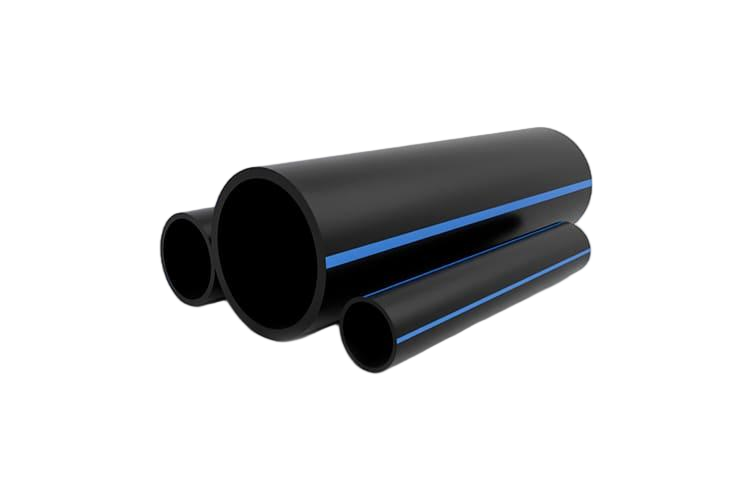
An engineering guide to HDPE / plastic borehole drop pipe (rising main, pump riser): why corrosion-free plastic replaces galvanised steel that rusts, scales and can drop the pump, the catastrophic dropped-pump economics, the axial-load engineering that is the heart of the job (pump + motor + water column + thrust), why jointing must be tension-rated (butt fusion, electrofusion, load-rated couplings) and why plain compression/insert fittings pull out, sizing the wall by SDR for pressure, load and collapse, solid-wall HDPE vs reinforced flexible rising main, and a safe install sequence.
Everything below the wellhead of a borehole hangs from one component: the drop pipe, also called the rising main or pump riser. It suspends the submersible pump and motor at depth and carries the pumped water back up to the surface, which makes it a structural member, not just a pipe. For decades that job fell to galvanised steel, and for decades galvanised steel has rusted, scaled and — at its worst — failed at a corroded joint and dropped the pump to the bottom of the bore, a catastrophe to recover. Corrosion-free plastic risers, both solid-wall HDPE and reinforced flexible rising main, remove that failure mode entirely. But replacing steel safely means getting one thing right above all others: the rising main carries a real suspended load, and its joints have to be engineered for it. This guide is built around that load.
What a borehole drop pipe / rising main does
The drop pipe is the vertical pipe column inside a borehole or well that does two jobs at once: it hangs the submersible pump and motor at the right depth below the water level, and it conveys the pumped water up to the wellhead. The rigid threaded-steel version is often called column pipe; the plastic versions are called drop pipe or rising main. The key point that shapes everything else is that this pipe is structural — it isn't just a passive conduit for water, it's carrying the entire weight of the pump assembly and the water inside it, suspended from the top. Get the conveyance wrong and you lose some flow; get the suspension wrong and you lose the pump. That's why a rising main has to be chosen and jointed as a load-bearing component, which is exactly where corroding steel falls down and corrosion-free plastic, sized and jointed correctly, comes into its own.
Why galvanised steel risers fail — and drop the pump
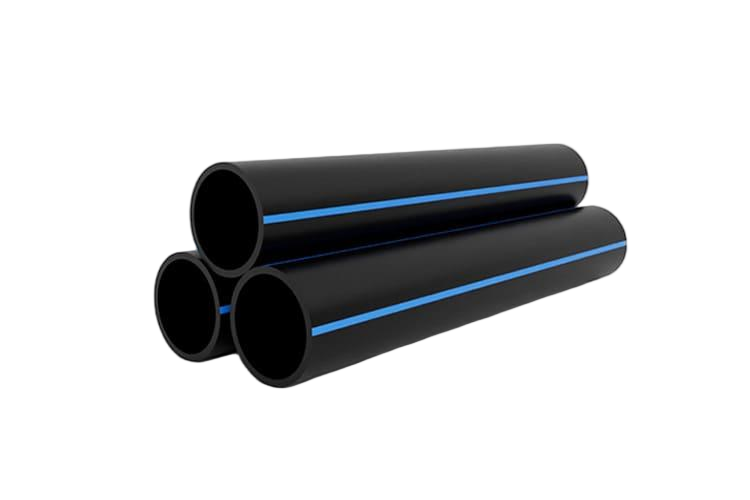
Galvanised steel risers fail in a predictable sequence. Aggressive, acidic or simply oxygenated groundwater attacks the zinc coating, and once that's gone the steel corrodes and scales — the scale chokes the bore and saps pump efficiency, while the corrosion eats into the threaded joints that hold the column together. It gets worse when dissimilar metals are involved: a brass or stainless fitting against bare cut steel threads sets up galvanic corrosion that attacks the steel fast. The endgame is the one every driller dreads: a weakened threaded joint lets go under the suspended load, and the pump falls to the bottom of the borehole. Typical galvanised risers last only fifteen to twenty years before this risk becomes real, less in acidic water. A corrosion-free plastic riser removes the entire mechanism — there's no zinc to lose, no steel to rust, no threads to corrode through — which is the single biggest reason plastic has displaced steel for this duty.
The engineering that matters: axial load
The heart of choosing a rising main is the axial (tensile) load it has to carry, because it's hanging vertically. That load is the sum of the weight of the pump and motor at the bottom, the weight of the column of water inside the pipe, and the dynamic and start-up thrust forces when the pump kicks in. Critically, this load is not shared evenly — the topmost joint, at the wellhead, carries the entire weight of everything below it, so it's the most highly stressed connection in the system. This is why a rising main can't be selected on its pressure rating alone: a pipe perfectly adequate for the water pressure can still be overloaded in tension by the suspended weight, and a joint that seals perfectly against pressure can still pull apart under the hanging load. Every part of the design — the wall thickness, the jointing method, the depth limit — has to be checked against this suspended load with an adequate safety factor, typically on the order of three to one between the joint's ultimate tensile strength and its safe working load.
Jointing for vertical suspension
Because the joints carry the full suspended weight, the jointing method is the make-or-break decision, and the table sorts what works from what doesn't. For solid-wall HDPE, butt fusion and electrofusion are ideal: they create a homogeneous joint as strong as the pipe wall itself, perfect for deep or heavy settings. Proprietary load-rated mechanical or anchor couplings — purpose-designed with positive-grip clamps — are also engineered for the tension and come with published safe-working-load ratings. What must never be used for vertical suspension are ordinary plain compression fittings, barbed insert fittings with worm-drive clamps, or push-fit couplings: they are not designed to resist sustained axial pull and will eventually pull out, dropping the pump. This is precisely why standard potable poly pipe joined with insert fittings is advised against below about thirty metres — beyond that depth the suspended load outgrows what those fittings can safely hold. Choose the joint for the load, not just the water pressure.
| Jointing method | Suitable for vertical suspension? | Notes |
|---|---|---|
| Butt fusion (solid HDPE) | Yes — preferred for deep/heavy | Homogeneous joint, as strong as the pipe wall |
| Electrofusion (solid HDPE) | Yes | Full-strength fused joint; good for fittings/repairs |
| Load-rated mechanical / anchor coupling | Yes | Positive-grip clamp with a published safe-working-load rating |
| Plain compression / barbed insert + clamp | No | Pulls out under sustained axial load — drops the pump |
| Push-fit coupling | No | Not designed to resist tension; for low-pressure conveyance only |
Sizing the wall: SDR for pressure, load and collapse
The wall thickness of a solid-wall HDPE rising main — expressed as its SDR, the ratio of diameter to wall thickness — has to satisfy three checks at once, not just one. First, internal pressure: the pump's head plus surge has to sit within the pipe's pressure rating (for PE100, SDR 11 is about 16 bar, SDR 17 about 10 bar, SDR 21 about 6 bar). Second, the suspended axial load: a thicker wall has more cross-sectional area to carry the hanging weight, so deep or heavy installations need a lower SDR. And third, external collapse: the pressure difference between the borehole annulus and the inside of the pipe (especially during heavy drawdown) can buckle a thin-walled pipe, and a lower SDR resists that too. The practical upshot is that the deeper the setting and the heavier the pump, the thicker the wall you need — lower-SDR pipe (down to SDR 9 or even SDR 7 for deep load-bearing duty) or a purpose-made load-rated rising main. Sizing on pressure alone, and ignoring the suspended load and collapse, is a classic and dangerous mistake.
Solid-wall HDPE vs reinforced flexible rising main
There are two distinct plastic answers to the steel-riser problem, and it's worth being clear they're different products. Solid-wall HDPE drop pipe is exactly what it sounds like — PE100 pipe, joined by fusion or load-rated couplings, that suits deep and heavy settings where its wall carries both the pressure and the suspended load. Reinforced flexible rising main (brand names like Boreline or Flexibore) is something else entirely: a woven polyester-reinforced polyurethane lay-flat hose, not HDPE at all, that comes on a drum and is paid out into the bore with the pump on the end, then pulled back up the same way. Both are corrosion-free and both eliminate the dropped-pump risk with load-rated stainless couplings, but they reach their depth differently — solid fused HDPE by its wall strength, flexible rising main by its woven reinforcement (with published safe-working loads up to several tonnes and continuous lengths to a few hundred metres). The shared, decisive idea is the same: a corrosion-free riser you can install and retrieve quickly without the corroding, pump-dropping threaded steel column.
HDPE vs steel, stainless & flexible rising main
Set against the alternatives, the corrosion-free plastics win clearly on the things that cause real-world failures, and the table lays it out. Galvanised steel is cheap upfront but corrodes, scales, and carries the highest dropped-pump risk over its short life. Stainless steel solves the corrosion but is expensive and heavy. Rigid PVC column pipe resists corrosion and reaches good depths in heavy schedules, but it's still jointed and threaded. Solid-wall HDPE is light, corrosion-free, and — fused — has very low dropped-pump risk and goes deep with the right SDR. Reinforced flexible rising main is the lightest and fastest to install and retrieve, corrosion-free, with load-rated couplings, ideal where pulling the pump quickly matters. The honest read is that for a permanent, deep, heavy installation solid fused HDPE (or stainless) is the workhorse, while for fast install/retrieval and shallow-to-medium settings the flexible rising main shines — and almost anything beats corroding galvanised steel for whole-of-life cost.
| Factor | Galvanised steel | Stainless | Solid HDPE (fused) | Flexible rising main |
|---|---|---|---|---|
| Corrosion | Poor (rusts in 15–20 yr) | Excellent | Excellent | Excellent |
| Internal scaling | High (chokes flow) | Low | Very low (smooth bore) | None internally |
| Dropped-pump risk | High (joint/thread failure) | Low | Very low (fused) | Very low (load-rated clamp) |
| Weight | Heavy (needs rig) | Heavy | Light | Very light |
| Install / retrieval speed | Slow (joint by joint) | Slow | Fast | Fastest (from a drum) |
| Best role | Legacy / lowest upfront | Deep, aggressive, permanent | Deep, heavy, permanent | Fast install, shallow–medium |
Installing & retrieving the pump
A rising main is installed and retrieved as a load-bearing column, and the sequence below keeps it safe. The two steps people skip are checking the jointing against the suspended load and fitting the safety and anti-rotation hardware — both of which exist precisely to stop a dropped pump.
5 mistakes that drop pumps
- Using plain compression, barbed-insert or push-fit fittings for vertical suspension — they pull out under the hanging load and drop the pump.
- Sizing the pipe on water pressure alone — ignoring the suspended pump + water-column weight (and start-up thrust) that the top joint must carry.
- Wrong SDR for the depth — under-rating the axial load and the drawdown collapse; deep/heavy settings need a lower SDR or load-rated reinforcement.
- No safety rope/sling, torque arrestor or cable guards — nothing to catch a failure, and start-up torque left to twist the riser.
- Using non-potable pipe or skipping the commissioning flush — contaminating the water; always use WRAS/NSF 61-certified pipe and flush to waste first.
Glossary
- Drop pipe / rising main / pump riser
- The vertical pipe column in a borehole that suspends the submersible pump and conveys water to the wellhead — a structural, load-bearing member.
- Axial (suspended) load
- The tensile load the riser carries: pump + motor + the water column inside + start-up thrust; the topmost joint carries all of it.
- Tension-rated joint
- A joint engineered for the suspended load — butt fusion, electrofusion, or a load-rated mechanical/anchor coupling (NOT plain compression/insert/push-fit).
- Pump 'fishing'
- Blind recovery of a pump dropped to the bottom of a bore after a riser failure — ~50:50 success, costing thousands; the mode plastic risers eliminate.
- Flexible rising main
- A woven-polyester-reinforced polyurethane lay-flat hose (e.g. Boreline) — corrosion-free, drummed, with load-rated couplings; a riser, but not HDPE.
- Torque arrestor
- A device that stops the riser twisting from the pump's start-up torque — standard practice on plastic risers.
References & standards
- [1]The Driller — Drop pipe load-bearing capacity (axial load & safety factor)
- [2]The Driller — Galvanized steel drop pipe corrosion (galvanic attack & dropped pumps)
- [3]Boreline — FlexiRiser — flexible rising main features
- [4]Proquip / Boreline — Boreline technical manual — safe-working-load table & install
- [5]SC Well Service — Drop pipe selection — PVC vs poly vs steel
- [6]RC Worst & Co. — Water-well pump drop pipe selection guide (depth limits)
- [7]Borehole Water Association of Southern Africa — Borehole pump installation practice
Frequently asked questions
Need expert advice on your project?
Our engineering team helps utilities, contractors and EPCs specify the right pipe material and SDR for their project. Get a no-obligation technical consultation.
Talk to an engineerRead next
15 min read
HDPE Pipe for Rural & Stock Water Supply Schemes: Long-Distance Reticulation Done Right (2026)
14 min read
Designing an HDPE Water Distribution Network: Layout, Sizing, Pressure & Leakage (2026)
13 min read
HDPE Service Connections & Tapping: Branch Saddles, Tapping Tees & Under-Pressure Tapping (2026)
13 min read
Connecting HDPE Pipe: Flanges, Stub Ends & Mechanical Joints (2026)
12 min read
HDPE Pipe Pressure Testing (Hydrostatic Leak Test): Procedure & Standards (2026)
Explore further
Related applications, material comparisons and country buying guides selected for this topic.