Application
HDPE Penstock Pipe for Hydropower: Sizing, Head & PN Guide
When HDPE PE100 is the right penstock material for small and mini hydro — how to size it from head, allow for surge, and where it beats steel.

Dr. Wei Liu, P.E.
Senior Engineering Manager · Primepoly
Published: Jul 5, 2026
Updated: Jul 5, 2026
11 min read
TL;DR
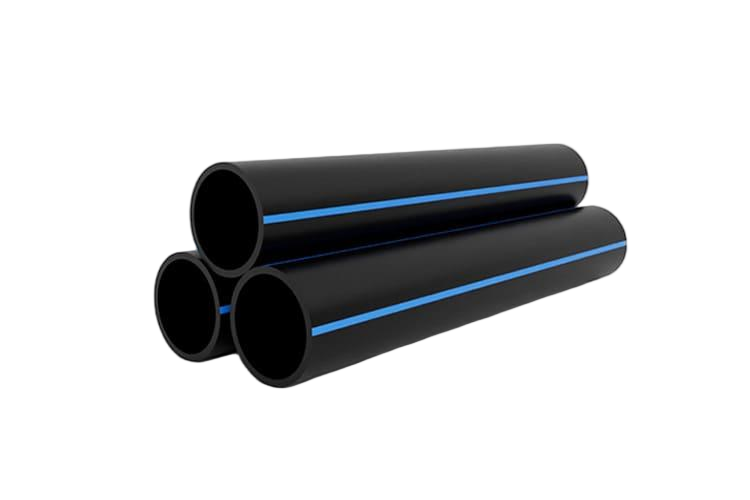
HDPE PE100 penstock pipe is the corrosion-free, leak-free choice for small and mini hydropower up to roughly 160 m head. This guide explains how to size an HDPE penstock from static head, allow for water hammer, choose the SDR/PN class, and when steel is still required.
The penstock is the pressure pipe that carries water from the intake or forebay down to the turbine in a hydropower scheme — and its material choice sets the plant's efficiency, leak risk and maintenance cost for decades. For small, mini and micro hydro on low-to-medium heads, HDPE PE100 has quietly replaced steel and ductile iron on many schemes: it never corrodes, its fused joints do not leak, its smooth bore loses less head to friction, and it is light enough to carry into remote sites. This guide shows exactly when HDPE is the right penstock, how to size it, and where steel is still needed.
What is a penstock — and where does HDPE fit?
A penstock is the closed conduit that delivers the working head of water to the turbine under pressure. The static pressure at the turbine equals the vertical drop (head) from the water surface to the machine — roughly 1 bar for every 10.2 m of head. On top of that static pressure, the penstock must survive transient surge (water hammer) when the turbine valve closes, which can briefly add 50–100% to the static pressure.
HDPE PE100 penstock pipe suits low-to-medium-head schemes — typically up to about 160 m of static head once a surge margin is included, in diameters up to DN1200 and beyond. Above that head, or for very large bores, steel (or a steel/HDPE hybrid) is still the norm. Within its range, HDPE's material properties make it the lowest-lifetime-cost option.
HDPE vs steel penstock
The case for an HDPE PE100 penstock is corrosion immunity, hydraulic efficiency and installation cost. Steel penstocks need coatings, linings and often cathodic protection, and their internal roughness (and therefore head loss) grows as they age; HDPE keeps a smooth bore for life. HDPE's heat-fused joints are as strong as the parent pipe, removing the flange and weld leak paths of steel, and the pipe's flexibility lets it follow terrain with far fewer bends, anchor blocks and fittings.
| Factor | HDPE PE100 | Steel |
|---|---|---|
| Head range | Up to ~160 m (with surge margin) | Any head, incl. high head |
| Corrosion | Immune — no lining or coating | Needs coating & cathodic protection |
| Joints | Butt-fused — as strong as the pipe | Welded / flanged — more leak paths |
| Internal roughness | Smooth for life (C ≈ 150) | Rougher; head loss grows with age |
| Terrain following | Flexible — few bends & anchors | Rigid — many bends & anchor blocks |
| Service life | 50–100 years | Depends on corrosion control |
Sizing an HDPE penstock: head, pressure and SDR
Sizing starts from the gross static head. Convert head to static pressure (1 bar ≈ 10.2 m), then choose a PE100 pressure class (PN) with margin above the static pressure to absorb surge. Because PE100 has a fixed design stress, each SDR maps to a fixed PN — a lower SDR is a thicker wall and a higher rating. The table below is a first-pass guide from static head to PE100 class; the final class must be confirmed by a transient (water-hammer) analysis for the specific scheme.
| Static head | ≈ Static pressure | PE100 class (before surge margin) |
|---|---|---|
| ≤ 40 m | ≤ 4 bar | SDR 26 / PN 6.3 |
| ≤ 60 m | ≤ 6 bar | SDR 21 / PN 8 |
| ≤ 100 m | ≤ 10 bar | SDR 17 / PN 10 |
| ≤ 160 m | ≤ 16 bar | SDR 11 / PN 16 |
| ≤ 200+ m | ≤ 20–25 bar | SDR 9 – SDR 7.4 / PN 20–25 |
Specifying HDPE penstock pipe
Beyond the pressure class, an HDPE penstock specification should call out: PE100 (or PE100-RC for buried/exposed runs over rough ground), the SDR/PN class from the transient analysis, the jointing method (butt fusion for the main run; flange adaptors at the turbine and valves), UV-stabilised black compound for any above-ground sections, and thrust/anchor design at bends. The decision flow below summarises the material choice.
Where HDPE penstocks are used
HDPE PE100 penstocks are standard on run-of-river mini and micro hydro, remote and off-grid community hydropower, irrigation-canal drop structures with energy recovery, and refurbishments where an aged steel penstock is being replaced without heavy lifting equipment on site. The same large-diameter PE100 pressure pipe also serves mine dewatering and high-static-head water transfer — applications that share the penstock's high-pressure, corrosion-free requirement.
HDPE penstock in one paragraph
For small, mini and micro hydropower up to roughly 160 m of static head, an HDPE PE100 penstock is usually the lowest-lifetime-cost choice: corrosion-free, leak-free fused joints, a permanently smooth bore that protects efficiency, and light enough for remote installation. Size it from the static head, add a surge margin confirmed by a transient analysis, pick the SDR/PN class, and specify PE100-RC where the ground is rough. Above ~160 m head or at very large diameters, steel still leads.
References & further reading
- [1]Plastics Pipe Institute (PPI) — PE Handbook — Engineering properties and design of PE pipe
- [2]AWWA — M55 Manual — PE Pressure Pipe: Design and Installation
- [3]ISO — ISO 4427 — Plastics piping systems for water supply (PE)
- [4]CEN — EN 12201 — Plastics piping systems for water supply and pressurised drainage (PE)
- [5]ASTM International — ASTM F714 — Polyethylene (PE) plastic pipe (DR-PR) based on outside diameter
- [6]PE100+ Association — Technical guidance on PE100 and PE100-RC pipe materials
Frequently asked questions
Need expert advice on your project?
Our engineering team helps utilities, contractors and EPCs specify the right pipe material and SDR for their project. Get a no-obligation technical consultation.
Talk to an engineerRead next
Explore further
Related applications, material comparisons and country buying guides selected for this topic.